An Executive Take on USM & AI in the RAN
Technology Foundations on USM & AI in the RAN
Cohere’s Universal Spectrum Multiplier (USM) software addresses the problem of congestion in mobile networks by effectively creating additional available spectrum (as much as double) when cells are at capacity. USM does this though an advanced new technique for allocating radio spectrum in real time to the many devices that need service, based not on RF modelling, but considering device location and speed, and other information about the channel between transmitter and receiving device.
With the USM’s Delay-Doppler channel model, Cohere has a real time view of everything in the wireless channel, much like an MRI of the wireless channel compared to time frequency channel models that are more akin to an x-ray.
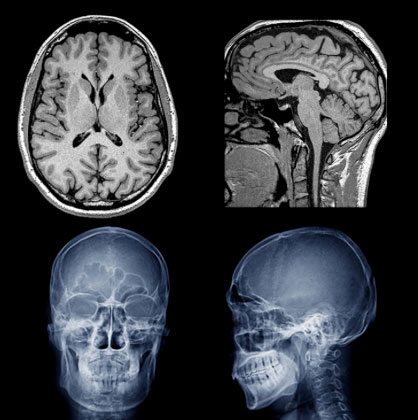
MRI vs. X-Ray
This means Cohere maps all energy, interference and reflectors, thereby creating a combined mapping of the physical world with the wireless world. The initial application for USM has been a “supercharged” scheduler within the base station, kicking in when cells are congested, reverting to a conventional scheduler under quieter loads.
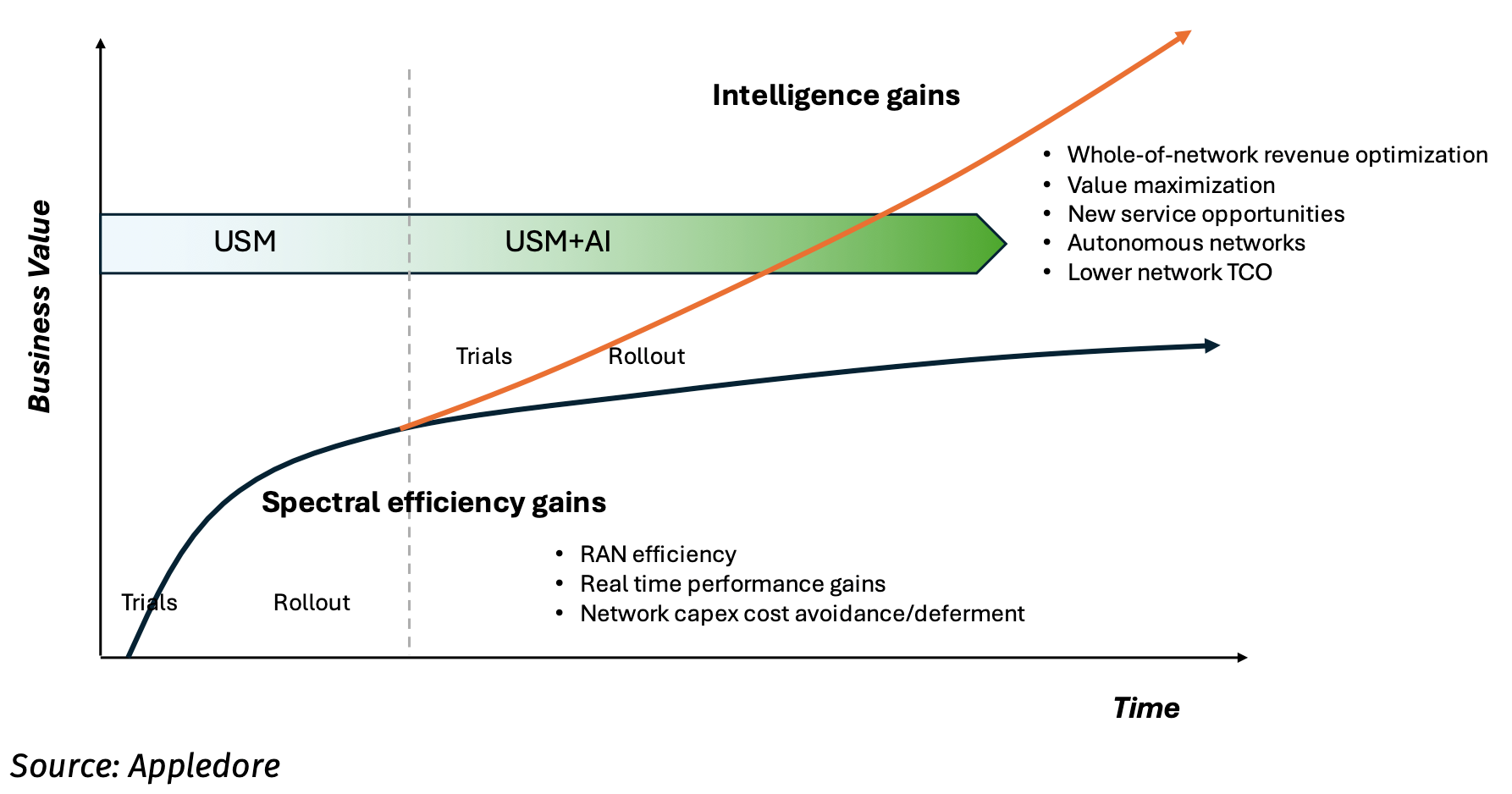
The next step in the USM evolution takes advantage of AI and cloud to harness and make sense of the real time data the USM generates in normal operations. This automated channel map information is foundational to creating “digital twin” style insights of the physical and wireless channel data of all energy in the wireless domain.
Emergence of the Intelligence Plane
Alongside conventional network control and data planes, this could be considered as a separate “intelligence plane”, providing a distinct resource about current and predicted network status and potential that can be used for a range of applications.
Pairing USM with AI is the next step. With a pre-existing basic channel model, or one developed from an IQ sample drive test of an area, a Retrieval Augmented Generative LLM architecture pattern is envisioned to develop learning models that explicitly reflect the characteristics of each cell. These future models will enable a new generation of digital twin that fuses the wireless and physical worlds. This twin can be used to model and recommend changes, along with augmenting capacity and financial planning for network improvements leading to more efficient spectrum utilization and improved network performance.
We are, indeed, living in exciting times.
ECHO (Enhanced Channel Insight with Holographic Observability)

The evolution of USM continues with a critical new capability: ECHO (Enhanced Channel Insight with Holographic Observability). Announced in May 2026, ECHO transforms USM from a real-time optimization tool into the data foundation that enables true AI-RAN.
What ECHO Provides
ECHO leverages USM’s geometric channel model to generate unprecedented real-time wireless channel insights. By logging 200 distinct attributes every second, ECHO generates over 400 million lines of telemetry per day per sector—a continuous, holistic view of the wireless channel.
This massive data stream reveals what conventional systems miss:
- Latency, motion vectors, amplitude, and visibility for every device
- Multi-user gain estimates showing optimization potential
- Angle of arrival distributions for precise traffic direction
- Spectral efficiency metrics calculated in real-time
- MU-MIMO scheduling percentages and performance indicators
ECHO Enables AI-RAN Optimization
Where previous approaches treated the wireless channel as a black box, ECHO makes it transparent. This enables AI systems to:
- Optimize Scheduling — Real-time resource allocation, grant size adjustment, MCS (Modulation and Coding Scheme) selection, and UE selection for multi-user MIMO all become data-driven.
- Manage Beams Dynamically — Beam selection and adjustment can be predicted and optimized using real-time angle of arrival and motion data, rather than reactive approaches.
- Allocate Power Intelligently — Per-device transmit power optimization based on actual channel characteristics, not statistical models.
- Detect and Mitigate Interference — Automatic identification of spectral interference with intelligent PRB blanking to prevent data loss.
- Optimize Multi-User MIMO — Dynamic selection of which users share PRBs based on real-time channel geometry and user separation.
Digital Twins and ISAC Capabilities
ECHO provides the data foundation for two transformative capabilities:
- Digital Twin Networks — Instead of relying on sparse, aggregated statistics, digital twin models are fed rich, real-time channel data from the physical network. This makes digital twins dramatically more accurate and responsive, enabling better scenario testing, predictive maintenance, and capacity planning.
- ISAC (Integrated Sensing and Communications) — ECHO enriches sensing capabilities on existing 5G base stations by providing geometric channel data, motion vectors, and angle of arrival information that enable both sensing and communications simultaneously.
Why ECHO Changes Everything
Conventional systems see only a fraction of available channel data. USM with ECHO maps the entire geometric channel in real-time, enabling AI to turn what appears random into deterministic performance. As Ray Dolan, Chairman and CEO of Cohere Technologies, noted: “At scale, ECHO delivers the data to realize AI RAN today.” By revealing the geometry of the wireless reflective environment, ECHO becomes the foundation for the next generation of network intelligence.
Deployment
ECHO is deployed by connecting to the standard E2SM-LLC API on the CU/DU. Critically, it works on all existing 5G base stations—even resource-constrained ones—because the API overhead is minimal. This means operators can deploy AI-RAN without the billions in hardware replacement costs that would otherwise be required.
Connection models are flexible:
- Persistent connection for continuous AI-RAN optimization
- Temporary connection for sector profiling activities and testing